
In short: Some swim schools ask babies to wear a disposable swim nappy underneath a fitted reusable swim nappy. This is called a double nappy system. The aim is to help contain poo accidents and reduce disruption to lessons. It does not make a nappy leak-proof or stop every germ from reaching the water.
If your swim school has asked you to bring two nappies, you might wonder whether you really need both, which one goes first, and whether the reusable nappy you already own will be accepted. Here is how to get the setup right without buying things you do not need.
On this page
- What is a double nappy system?
- Why swim schools ask for two nappies
- What the research shows
- What to check before buying
- How to put the nappies on
- Before, during and after your lesson
- When to skip swimming
- Frequently asked questions
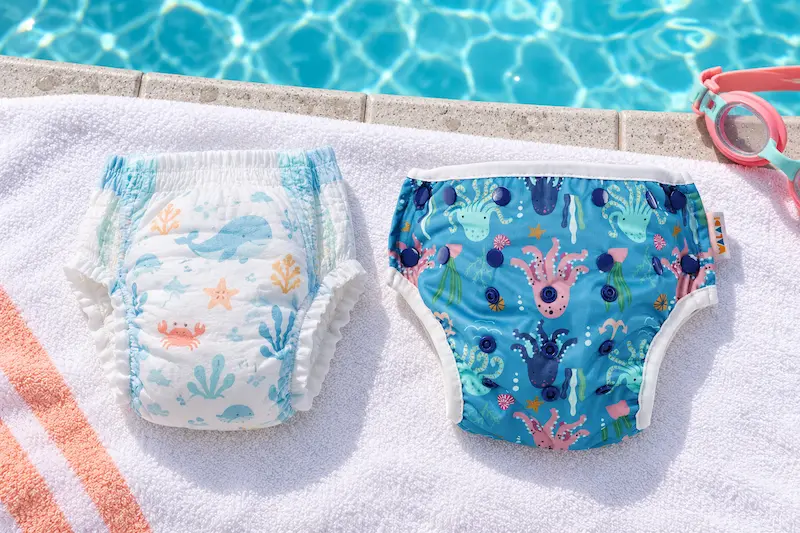
What Is a Double Nappy System?
For many Australian swimming lessons, it means wearing these items together:
| Layer | What your baby wears | What to check |
|---|---|---|
| First | A disposable swim nappy | It must be made for swimming, not a regular absorbent nappy. |
| Second | A fitted reusable swim nappy or approved swim-nappy cover | Your school must accept the particular type, and it needs to fit properly over the inner nappy. |
| Optional extra | A swimming costume or rashie | Follow your venue’s swimwear requirements. Ordinary swimmers do not automatically count as a second nappy. |
For example, Parramatta Aquatic Centre’s swim-school policy requires swimmers under three to wear a disposable swimming nappy with a reusable one over the top.
Other schools may accept an approved reusable inner nappy and outer cover, or a product with an integrated double system. Do not assume any two nappies will meet the rule. Ask your school which combination it accepts.
Why Do Some Swim Schools Require Two Swim Nappies?
The aim is extra containment, not extra absorbency
A second fitted layer provides another physical barrier intended to help contain material that escapes the inner nappy. It is a precaution, not a guarantee. Swim nappies are designed to help hold solids, not to absorb wee like an everyday nappy.
That distinction matters at the change table, too. A baby wearing two swim nappies can still wet their clothes or car seat before or after the lesson. Use a regular nappy for the journey and change into the swimming setup at the venue.
A poo accident affects more than one family
From the pool’s point of view, an accident is not simply a mess to scoop out. Staff need to assess the contamination and follow their response procedure. The affected pool may need to close while cleaning and treatment take place, interrupting lessons for other families.
The CDC’s pool-contamination guidance treats diarrhoea as a particularly high-risk event. The response depends on what happened and the pool’s treatment system, so there is no single closure time that applies to every accident.
Chlorine does not kill every germ straight away
Chlorine is important, but some germs tolerate it much better than others. Cryptosporidium, often called Crypto, can survive for days in properly chlorinated water. It can spread when someone swallows contaminated water.
This is a real Australian public-health concern. Victoria recorded 2,350 cryptosporidiosis notifications in 2024, according to the Victorian Department of Health. Those notifications cover different sources of infection, not just pools, and do not show how many cases involved babies or nappies.
For parents, the takeaway is simple: the nappy is one precaution. Staying home when unwell, checking nappies and changing them properly still matter.
What Does the Research Say About Swim Nappies?
The research helps explain both why swim nappies are useful and why schools cannot rely on them alone.
They can hold much of the solid material
A 2004 study by Maas and colleagues in the Journal of Environmental Health compared three disposable swim-nappy brands with ordinary disposable nappies during simulated water play.
The swim nappies retained approximately 98-99% of fine solids over 30 minutes. The regular nappies fell down or came apart during testing. Some solid material still escaped from the swim nappies.
This supports choosing a purpose-made swim nappy rather than a regular nappy. It does not mean swim nappies prevent 98-99% of infections.
Microscopic particles can escape quickly
A 2011 study by Amburgey and Anderson in the Journal of Water and Health used tiny, non-infectious particles similar in size to Cryptosporidium. Researchers placed the particles inside swim nappies worn during simulated swimming and play.
Across the tested arrangements, 50-97% of the particles escaped within one to five minutes. After ten minutes, 77-100% had escaped.
These were surrogate particles, not live parasites or measured infections. The study did not test Waladi nappies or establish how much today’s disposable-plus-reusable systems reduce illness.
What this means for your baby’s lesson
Holding most solid material and stopping microscopic germs are different jobs. The two studies measured different things, so their results are not contradictory.
They also do not give us a reliable percentage for how much safer a modern double nappy system is than one correctly fitted swim nappy. The sensible approach is to follow your school’s approved setup without treating it as complete protection.
The CDC’s advice on swim nappies makes the same key distinction: swim nappies may contain some solid poo, but they are not leak-proof and do not reliably prevent diarrhoea-associated germs from entering the water.
What Should Parents Check Before Buying?
Before adding another nappy to your basket, ask your swim school:
- Does my child need two swim nappies, or is one approved reusable nappy enough?
- Is a disposable inner compulsory, or do you accept a reusable inner?
- Do you require a particular cover, material, design or brand?
- Does the rule depend on age, toilet training, or both?
- Can you check the fit before our first lesson?
A useful question is: “Can my baby wear this reusable swim nappy over a disposable swim nappy, or do you require a different type of cover?” Show staff the actual product rather than relying on the words “reusable” or “double layer”.
If your school accepts this style, Waladi reusable swim nappies are a practical option to consider. They have adjustable snaps, a waterproof PUL outer and a mesh lining designed to help hold solids. The adjustable sizing suits approximately 3.5-15kg, but the fit on your baby matters more than the weight range alone.
Waladi swim nappies are not neoprene covers. If your school specifies a neoprene design or another approved product, check with staff before buying. A waterproof fabric does not make the whole nappy watertight or germ-proof.
Choose a print for your next swim
Once you have checked your school’s requirements, choosing a print is the fun part. These three Waladi swim nappies have the same adjustable design, so you can simply pick your favourite.
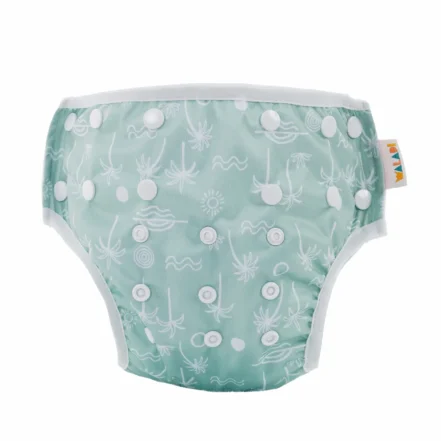
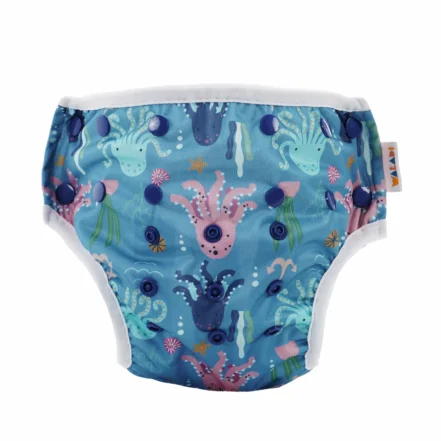
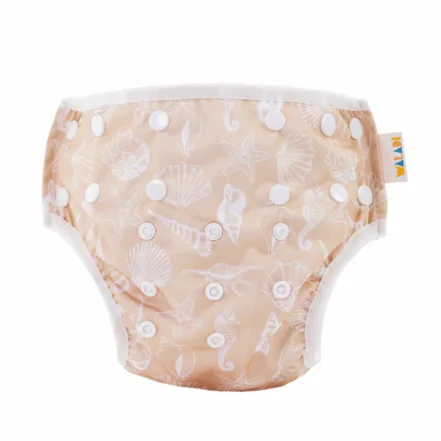
For the wider requirements, see our guide to swim-nappy rules at Australian pools.
How to Put On a Double Nappy Setup
These steps apply when your school asks for a disposable swim nappy underneath an approved reusable one:
- Start with a clean baby. Remove the everyday nappy and clean your baby’s bottom before fitting the swim nappies.
- Fit the disposable swim nappy first. Follow its sizing instructions and check that it sits securely.
- Add the approved reusable outer. Fit it over the disposable without bunching the inner nappy.
- Check the waist and legs. Look for gaps, loose areas or uncomfortable tightness. Check again as your baby moves.
- Add any required swimwear. It should not pull either nappy out of position.
- Ask for help if the fit is wrong. Do not automatically buy a larger outer nappy, as that may leave gaps.
With Waladi’s adjustable snaps, take a moment to check the fit each visit as your baby grows. If the approved combination feels bulky or cannot sit comfortably, ask the school or supplier for help rather than forcing the layers together.
Do not add your everyday cloth-nappy insert to the swimming setup. It is designed to absorb liquid, which is a different job from containing solids in the pool.
A Simple Routine Before, During and After Lessons
Before you leave home
Pack the required nappies, spare approved swim nappies, a towel, changing supplies, clean clothes and a regular nappy for afterwards. A reusable wet bag helps keep used swimwear separate on the way home.
If you are comparing reusable and disposable swim nappies, remember that your school’s policy may mean you need both. A reusable outer does not remove the cost of a compulsory disposable inner.
At the pool
Change in the designated area and leave enough time to check the layers before class. Shower as directed by the venue. Keep watching for signs your baby needs a change, even during a short lesson.
Victorian healthy-swimming guidance recommends checking nappies every 30-60 minutes and taking children for toilet breaks every hour. Check immediately if you suspect soiling; do not wait for the next scheduled break.
If your baby does a poo
Leave the water promptly and use the designated change area. Clean your baby and replace the soiled nappies. If poo has escaped, or you are unsure whether it has, tell pool staff straight away and follow their instructions before returning.
Accidents can happen. Telling staff quickly helps them respond; there is no need to hide it or feel embarrassed.
After the lesson
Change back into a regular nappy before heading home. Put disposable swim nappies in the appropriate bin and keep used reusable items separate from clean clothes.
Follow each reusable product’s care instructions. For Waladi swim nappies, remove solids into the toilet, rinse, machine wash according to the care label and air dry. Avoid high heat and prolonged hot direct sun. A reusable outer needs cleaning too, even when a disposable was worn underneath.
When Two Nappies Are Not Enough: Skip Swimming When Unwell
Do not take a child swimming with diarrhoea, even in two swim nappies. Victorian guidance advises staying out of the pool for two weeks after diarrhoea stops, including after cryptosporidiosis and diarrhoea of unknown cause. Follow local health advice and your venue’s illness policy.
If you are unsure whether a change in your baby’s usual stools is diarrhoea, ask a health professional. Do not rely on an extra layer to make an unwell child ready for swimming.
Good hygiene matters between changes, too: use designated changing areas, wash hands with soap afterwards and help your child avoid swallowing pool water.
A Little Preparation Makes the Rule Easier
From a parent’s point of view, the best setup is one you understand, can fit comfortably and know the school will accept. From the pool’s point of view, it is one part of a wider routine that includes hygiene, water treatment and keeping unwell swimmers out.
Check the policy first, choose the right size, and bring spares. Where your school accepts Waladi’s style, our adjustable reusable swim nappies offer a washable option in prints you can choose for your little swimmer. Use them with any additional layer the school requires, rather than assuming one product replaces the whole system.
Frequently Asked Questions
Do two disposable swim nappies count as a double nappy system?
Do not assume so. A school’s double nappy policy usually describes an approved inner nappy and a fitted reusable outer or cover. Two disposable swim nappies are not automatically an accepted substitute. Ask the school which combination it requires.
Can I use two reusable swim nappies instead of a disposable?
Only if your swim school accepts that exact arrangement. Some systems use an approved reusable inner and outer, but two arbitrary reusable nappies may not fit properly together or meet the policy. Confirm the combination before buying.
Does a swim nappy with two fabric layers count as two nappies?
Not automatically. Two layers of fabric in one nappy are different from a school’s approved double nappy system. Ask whether the particular product meets the requirement rather than relying on its layer count.
Does my toilet-trained toddler still need a double nappy?
That depends on the venue. Some policies use an age limit as well as toilet-training status. Check your school’s current rule rather than assuming the requirement ends as soon as your child is toilet trained.
Can Waladi swim nappies be used for swimming lessons?
Waladi makes reusable swim nappies with adjustable snaps and a mesh lining designed to help hold solids. Before using one for lessons, confirm that your school accepts this style and ask whether another layer is required. Waladi swim nappies are not neoprene covers, and school approval should not be assumed.